

Strategy
Part of Planning permission and business licences: which decision to settle first
Ninety days from activity mapping to a controlled launch decision
Use a ninety-day England licensing plan to map activities, confirm authorities, prepare evidence and make a controlled launch decision for operators.
A ninety-day licensing plan should reduce uncertainty in a sensible order. It cannot promise an authority decision within the period. The aim is to identify material permissions early, prepare reliable evidence and prevent an unresolved requirement from being mistaken for launch readiness.
What to take away
- The plan reduces uncertainty in a sensible order but cannot promise an authority decision within ninety days.
- Identify material permissions early and prepare reliable evidence so unresolved requirements are not mistaken for launch readiness.
- Confirm the responsible body for each activity and location before treating any permission as settled.
- Place gates before lease commitments, equipment purchases and advertised dates to control exposure.
- End day 90 with a signed decision note.
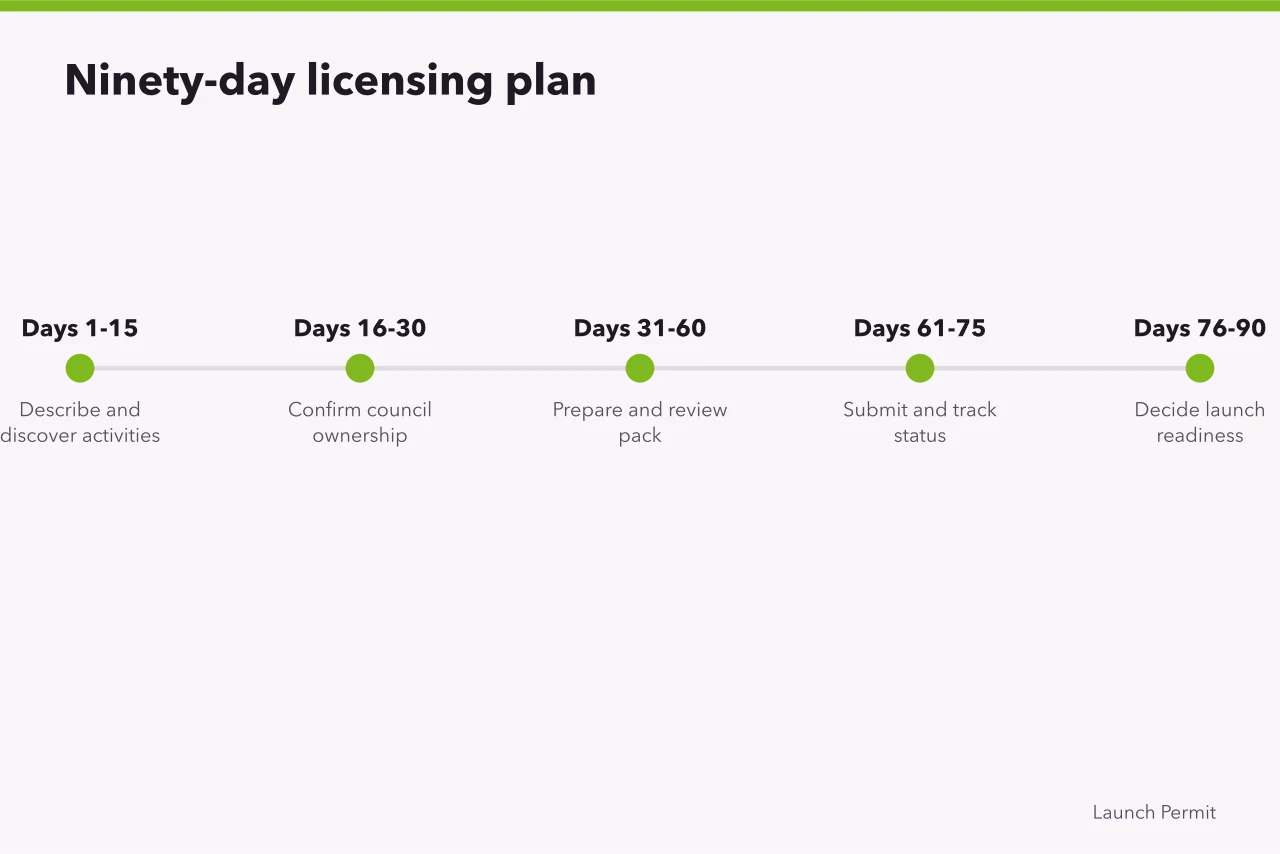
Days 1 to 15: describe and discover
Write the actual activities, sites, hours, products, responsible people and environmental effects.
Common England licences include premises licences for alcohol and late-night refreshment, food business registration, street trading consents and waste carrier registrations.
Use the Department for Business and Trade's Find a licence service to search by activity and place. It covers the four nations through filters and warns that its catalogue may not be exhaustive.
Activity register row
- Activity and location
- Hours and products
- Responsible people
- Environmental effects
- Statuspossible until confirmed
Create one register row per activity and location. An example row looks like this:
| Activity | Site | Authority | Status | Cost of being wrong |
|---|---|---|---|---|
| Sale of alcohol for consumption on premises | Unit 4, example retail park | Local licensing authority | Possible | Lease commitment before licence granted |
Mark each result possible until the responsible body is confirmed. Rank unanswered questions by the cost of being wrong.
Days 16 to 30: confirm ownership
For local processes, find the council for each postcode through the GOV.UK council service. Open the authority's current route and capture evidence requirements, contact details and source date. Do not copy another council's form into the plan.
Place gates before lease commitments, equipment purchases and advertised dates. Decide who can pause the project when evidence is missing.
Days 31 to 60: prepare and review
Build the application pack in a controlled folder. Check names, addresses, activity descriptions, plans and policies against the live instructions. The Food Standards Agency's food business registration guidance explains covered food activities and treatment of multiple establishments for England, Wales and Northern Ireland. A food operator should use that route without assuming it settles alcohol or other permissions.
Run a second-person review before submission. Keep the exact version sent and record unknowns that require authority or professional clarification.
Days 61 to 75: submit and track
Record reference numbers, acknowledgements and requests for more information. Separate submitted, acknowledged and decided statuses. Reply through the official channel and preserve material correspondence where a deputy can recover it.
Authority decision timescales vary. Food business registration and waste carrier registration are online and can be quick, though food registration must be done at least 28 days before opening. Premises licences typically take around eight weeks, and planning decisions often take eight to thirteen weeks.
Special cases need the correct owner. GOV.UK's child performance licence route directs organisers in Great Britain to the child's council and states a separate Northern Ireland path. That geography and responsible council should be checked for the actual event rather than copied from a general timeline.
Weekly control routine
Hold a brief case review across the ninety days, focusing on decisions that could stop trading or make a commitment expensive to reverse. For each, confirm the latest evidence, owner and next action. Ensure a colleague can find the application version, acknowledgement, authority contact and unresolved question without searching a private inbox. Publish a decision log after each meeting.
Days 76 to 90: decide launch readiness
Compare planned operations with granted permissions and conditions. Translate restrictions into staff instructions, supervision, displayed information or logs. Put renewal and change triggers into the calendar. If a required decision remains outstanding, label the launch conditional and choose whether to postpone or redesign.
End day 90 with a signed decision note containing the operating facts, sources, authority responses, unresolved exposure and accountable owner. Reopen it whenever the site, activity, operator or hours change.
A minimal template for the note:
- Decisionlaunch, conditional launch or postpone.
- Operating factssite, activity, hours, products, responsible people.
- Permissionsgranted, outstanding, refused.
- Exposureunresolved risks and cost of being wrong.
- Accountable owner and date.
Before you act
- Write the actual activities, sites, hours, products, people and environmental effects.
- Create one register row per activity and location, marking results possible until confirmed.
- Find the council for each postcode and capture current evidence requirements.
- Run a second-person review before submission and keep the exact version sent.
- Record reference numbers, acknowledgements and requests for more information.
Common questions
What should the first fifteen days of the plan cover?
Write the actual activities, sites, hours, products, responsible people and environmental effects. Use the Find a licence service to search by activity and place. Create one register row per activity and location, mark each result possible until the responsible body is confirmed, and rank unanswered questions by the cost of being wrong.
How should special cases such as child performance licences be handled?
GOV.UK's child performance licence route directs organisers in Great Britain to the child's council and states a separate Northern Ireland path. That geography and responsible council should be checked for the actual event rather than copied from a general timeline. Special cases need the correct owner.
What happens if a required decision is still outstanding at day 90?
Put renewal and change triggers into the calendar. If a required decision remains outstanding, label the launch conditional and choose whether to postpone or redesign.