Costs and pricing
Business licences costs and pricing: a budgeting method
Business licences costs and pricing depend on the activity. Budget by separating charges, preparation and uncertainty, with a Leeds band A example.
A business licence rarely costs just the application fee, though an English operator may also need plans, notices, inspections and professional help. Staff time, remedial work and continuing controls add further cost.
Some activities have no licence fee but still create preparation and operating costs. A useful budget separates these elements and ties each current figure to the exact authority record.
Business licences costs and pricing vary by activity, authority and case, and live pages can change. This guide sets out how to budget for them from each responsible source rather than reproducing a national price list. Reopen that source before approving spending or quoting a customer.
What to take away
- Separate official charges from preparation, external support, operational compliance and uncertainty in your budget.
- Link every current figure to the exact authority record and check the access date before approving spending.
- Use low, central and high cases to show assumptions that move the range, not a large anonymous contingency.
- Keep delay exposure separate from the application budget because it depends on your own commitments.
- Tie spending approval to evidence milestones and reconcile the workbook to the licence register.
Define what the budget covers
Begin with one activity at one site. Record the authority, application route, planned date and decision that depends on permission. A budget for opening a premises is different from a supplier quote for managing the application and different again from the cost of operating conditions after approval.
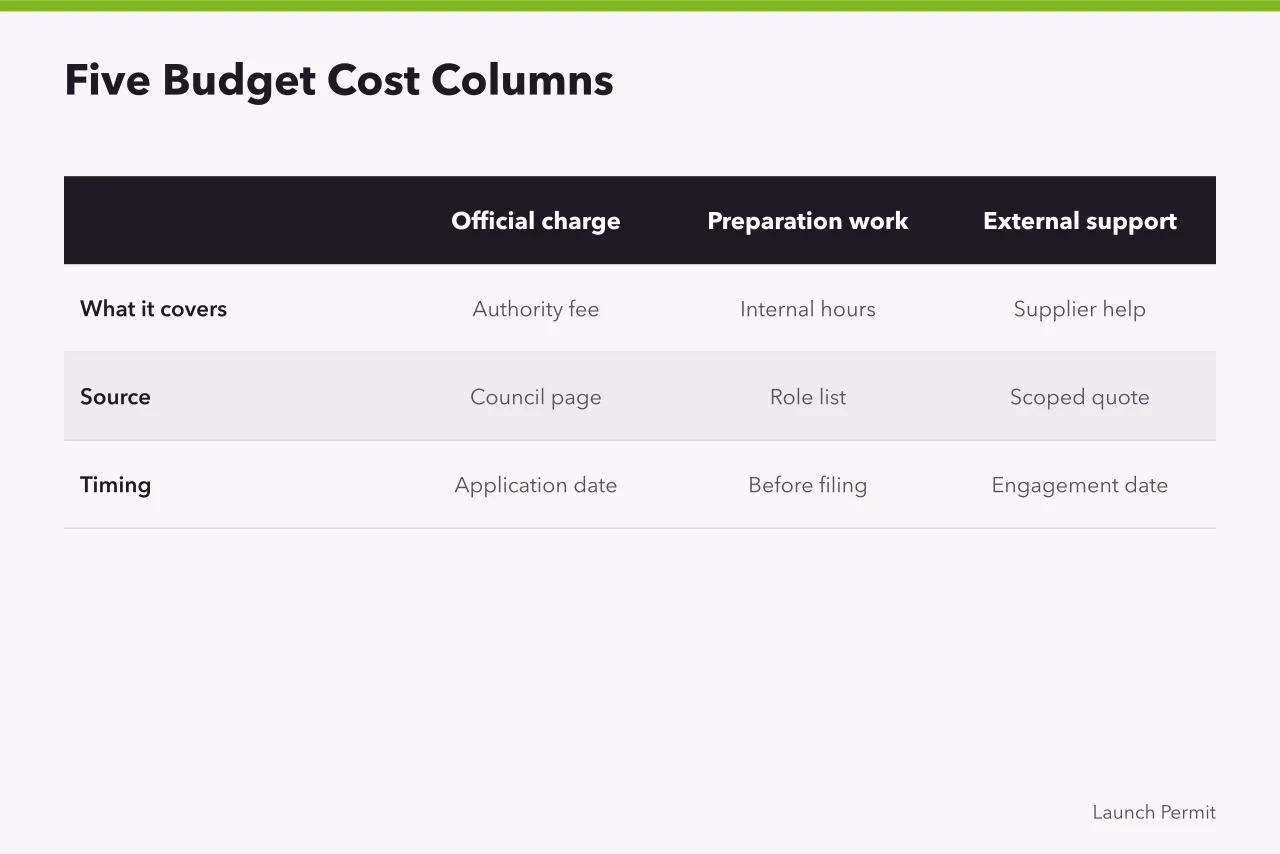
Create five columns: official charge, preparation work, external support, operational compliance and uncertainty. Add a sixth for timing exposure where delay could affect rent, staffing or launch commitments. Keep value added tax treatment, if relevant, and payment timing visible rather than blending everything into a single allowance.
The Department for Business and Trade's guidance on dealing with licences and regulations encourages founders to identify regulatory needs and responsible bodies while planning. It covers the UK. The actual figure still needs the current England-specific regulator or council page.
Supplier quotes for plans, agency work and specialist reports normally exclude VAT. The standard rate is 20% where the supplier is registered. A VAT-registered business can normally reclaim that input tax where the cost relates to its taxable supplies, subject to partial exemption rules.
Statutory charges are different, so ask the council or regulator whether the specific fee carries VAT before you gross it up.
Payment dates also differ. Application fees are usually payable when you submit, annual charges fall due on the anniversary of the grant, and non-payment can suspend a licence. Check the authority's terms and diarise each date. Supplier invoices often follow stages, so record the trigger for each payment.
Match the activity to the licence family and regulator
England divides licence work between local councils and national regulators. The family tells you who sets the charge and where the application goes.
| Licence family or activity | Usual regulator in England |
|---|---|
| Premises licence and personal licence for alcohol, regulated entertainment and late night refreshment | Council licensing authority for the premises |
| Street trading licence or consent | Council for the proposed trading area |
| Food business registration | Council environmental health team |
| Animal activity licence, such as boarding, breeding or a pet shop | Council, under Defra statutory guidance |
| Taxi and private hire driver, vehicle and operator licences | Council, or Transport for London in the capital |
| Scrap metal dealer licence | Council |
| House in multiple occupation licence | Council |
| Waste carrier registration | Environment Agency |
| Environmental permit for a larger site | Environment Agency |
| Gambling operating licence | Gambling Commission |
| Gambling premises licence | Council |
Start with the family, then find the authority for the trading address through the council finder in the next section. Waste, environmental and gambling operating routes begin on the regulator's own site.
Capture authority charges from the owner of the route
Many permissions are locally administered. Use GOV.UK's council finder with the address or trading-place postcode, then open the responsible council's current fee and application information. Retain the page, access date, relevant activity and any assumptions used.
Find the Local Authority Charge
- Enter address or trading postcode
- Open responsible council fee page
- Retain page and access date
- Record activity and assumptions
- Ask authority if basis unclear
Do not copy a fee from a neighbouring authority. A published amount may depend on premises, duration, rateable value, category or other facts, so ask the authority when the basis is unclear.
Street trading illustrates local variation. GOV.UK's street trading licence page directs applicants in England and Wales to the council for the proposed area and notes that local conditions, timing and fees may apply.
Separate application, annual and change costs
A licence family may contain initial applications, variations, transfers, renewals, annual charges or event-specific routes. The GOV.UK premises licence record sends applicants in England and Wales to the local authority and describes covered activities. Budget each required transaction at its own date and source.
Licence Cost Events
- ApplicationInitial fee and evidence
- VariationChange of activities or hours
- TransferNew operator or owner
- RenewalPeriodic reapplication
- Annual chargeRecurring authority fee
- ReviewCondition controls and changes
Do not assume that a grant closes the cost line. Add expected review work, condition controls and future changes. A business that changes its hours, operator or activities may need to reopen the licensing analysis even where the current permission has no immediate expiry.
Cost internal preparation hours by role
List internal hours by role: operations, premises, finance, data, management and legal or technical review. Include gathering plans and policies, checking declarations, answering authority questions and training the people who will operate conditions. Use an agreed internal cost basis and state it.
External costs may include drawings, notices, specialist reports, translations, accessibility support or professional advice. These are examples of categories, not claims that every application needs them. Tie each item to the current route or a scoped supplier quote.
The Department for Environment, Food and Rural Affairs' animal activity licensing process describes application, inspection, decision, renewal and enforcement within its English regime. It shows why inspection and ongoing operation belong in that activity's budget without setting prices for other permissions.
Budget operating conditions
After a decision, translate conditions into costs the organisation can control. These might involve staff supervision, recordkeeping, maintenance, restricted operating hours, storage or displayed information. Link every cost to the actual granted condition, not a generic list borrowed from another business.
Food registration provides a different boundary. The Food Standards Agency's food business registration guidance covers specified food activities and the treatment of multiple establishments in its stated jurisdictions. An operator still needs to budget the practical controls required for its operation.
Give each continuing duty an owner and review frequency. The budget should cover the people and records needed to maintain compliance, not simply the point of application.
Create low, central and high cases
Use ranges for uncertain work. The low case includes confirmed charges and straightforward preparation. The central case adds the most plausible clarification or remedial effort. The high case reflects identified risks, such as a changed plan or additional professional work, without pretending to forecast an authority outcome.
Show the assumptions that move the range. Do not add a large anonymous contingency. A reader should see whether uncertainty arises from missing facts, an unconfirmed fee, site work or unresolved advice.
Keep delay exposure separate from the application budget. Rent, idle equipment or lost trading can be commercially important, but those figures depend on the organisation's commitments. Do not attribute all delay to licensing or claim that paid support will eliminate it.
Worked example: a band A cafe premises licence
A cafe in Leeds applies to Leeds City Council for a premises licence. The Licensing Act 2003 (Fees) Regulations 2005 set the application fee and the annual charge by rateable value band, so every licensing authority in England uses the same band figure. Band A covers a rateable value up to £4,300: £100 to apply and £70 a year.
Above band A the schedule steps up with rateable value, so a larger site pays more. Confirm your band and the current amounts on the council's fee page before you commit.
The table uses illustrative figures for internal hours, supplier quotes and advertising. Only the two statutory charges are published national amounts.
Basis
- Premises licence application, band A
- National figure for rateable value up to £4,300
- First annual charge, band A
- National figure, due on the grant anniversary
- Internal preparation, 10 to 20 hours by role
- Illustrative internal cost of £20 an hour
- Plans and drawings
- Illustrative supplier quote
- Licensing agent
- Illustrative quote, before VAT
- VAT at 20% on plans and agent work
- Illustrative
- Newspaper notice
- Illustrative, required with a premises licence application
- Total
- Illustrative
Low case
- Premises licence application, band A
- £100
- First annual charge, band A
- £70
- Internal preparation, 10 to 20 hours by role
- £200
- Plans and drawings
- £0
- Licensing agent
- £0
- VAT at 20% on plans and agent work
- £0
- Newspaper notice
- £0
- Total
- £370
Central case
- Premises licence application, band A
- £100
- First annual charge, band A
- £70
- Internal preparation, 10 to 20 hours by role
- £300
- Plans and drawings
- £150
- Licensing agent
- £450
- VAT at 20% on plans and agent work
- £120
- Newspaper notice
- £250
- Total
- £1,440
High case
- Premises licence application, band A
- £100
- First annual charge, band A
- £70
- Internal preparation, 10 to 20 hours by role
- £400
- Plans and drawings
- £250
- Licensing agent
- £900
- VAT at 20% on plans and agent work
- £230
- Newspaper notice
- £400
- Total
- £2,350
Rent sits outside this table. If the unit is already let at an illustrative £600 a week, the 28 day representation period is about £2,400 of exposure on its own.
Compare supplier pricing on equal scope
Fixed, hourly, staged and managed-service quotes can all be reasonable. First define the deliverable, exclusions, customer duties and authority boundary. A fixed discovery report is not comparable with full application representation, and a monthly renewal service is not the same as one-off filing.
Ask which authority charges and third-party expenses are included, how extra work is authorised and what happens if the facts change. The official Unfair Contract Terms Act 1977 may be relevant to some liability restrictions, but a qualified reviewer should assess material contract terms in context.
Avoid success-fee language that implies the supplier controls approval. Keep referral payments and commercial relationships visible where they affect a recommendation or quote.
Build a budget workbook
Use one row per cost item with activity, site, category, source, access date, quantity, unit assumption, low case, central case, high case, payment date, owner and status. Add an evidence link for every official amount and attach a dated supplier quote for every external service.
Separate confirmed, estimated and unknown values. A zero should mean the amount is genuinely nil, not that research has not been completed. Use formulas that can be inspected and include a version note when an assumption changes.
Reconcile the workbook to the licence register. Every material permission should have a corresponding budget review, and every licence-sensitive cost should point back to an activity or condition.
Approve spending in stages
Do not release the whole allowance merely because the annual budget has been signed off. Tie spending approval to evidence milestones. Early discovery may justify a small research budget, while plans, specialist reports or a substantial supplier engagement should wait until the activity, authority and intended route are clear.
Set an owner for each approval and record which assumption remains. If a required permission is refused or the business chooses a different site, close or revise dependent commitments rather than letting purchase orders continue automatically. Where cancellation charges or deposits apply, show them in the decision note before commitment.
At monthly review, compare forecast, committed and paid values. Investigate changes by cause: updated authority charge, revised operating facts, extra evidence, customer delay or supplier scope. This avoids describing every variance as an unexpected licensing cost and helps the organisation improve later estimates.
Measure licence handling time and rework
Track a few licence-specific measures: hours spent on each application or renewal, questions raised by the authority, applications returned for missing evidence, time taken to retrieve conditions and records, and condition-related incidents logged. Government Digital Service guidance on using data to improve a service supports measures linked to user needs, baselines and decisions.
Set a baseline before you change the process, then compare the same licence task or the same trading period. State the period and what would have happened without the change. Do not credit a supplier with every approval or with all revenue after launch.
Run a final budget challenge
Ask whether the correct authority and activity were used, whether each current figure has a first-party source, whether ongoing conditions are represented and whether supplier scopes are comparable. Check for hidden reliance on one employee, private inbox or inaccessible platform.
The next step is to choose the licence-sensitive activity with the largest commercial consequence and complete its six cost columns. Resolve unknown official charges at source, obtain scoped quotes and keep the opening decision conditional until the budget and permission evidence align.
Before you act
- Define one activity at one site with its authority and route.
- Open the responsible council's current fee and application page.
- List internal hours by role and state your cost basis.
- Translate granted conditions into controllable operating costs.
- Create low, central and high cases with visible assumptions.
- Attach dated supplier quotes and separate confirmed, estimated and unknown values.
Common questions
Why should I not copy a licence fee from a neighbouring authority?
A published amount may depend on premises, duration, rateable value, category or other facts. If the basis is unclear, leave the amount unresolved and ask the authority rather than choosing the lowest visible number. Street trading illustrates local variation, so a local check is needed, not a national price.
How should I handle uncertainty in my licence budget?
Use ranges for uncertain work. The low case includes confirmed charges and straightforward preparation. The central case adds the most plausible clarification or remedial effort. The high case reflects identified risks without pretending to forecast an authority outcome. Show the assumptions that move the range and avoid a large anonymous contingency.
What should I check before comparing supplier pricing?
First define the deliverable, exclusions, customer duties and authority boundary. Ask which authority charges and third-party expenses are included, how extra work is authorised and what happens if the facts change. A fixed discovery report is not comparable with full application representation, and a monthly renewal service is not the same as one-off filing.
In this guide
- Cost guide data and sources: the record to keep for every licensing fee you publishKeep one source record for every figure in a licensing cost guide, with authority, page, date, basis and band, so a second person can reproduce each fee.
- Fixed, hourly, staged or subscription? Pricing licensing support on equal scopeCompare fixed, hourly, staged and subscription pricing for England licensing support using equal scope, exclusions, evidence and exit terms.
- A licensing budget template that records official sources, preparation and payment timingUse an England business-licensing budget template that records official sources, preparation, operating controls, payment timing and uncertainty.
- Return on licensing support, assessed through baseline, plausible contribution and a rangeAssess return on investment for England licensing support through a baseline, defined service contribution, measured rework and honest uncertainty.
- The licensing costs nobody budgets for, from finding the right authority to remediationFind hidden costs in England business licensing, including preparation, local variation, inspections, conditions, changes, delay and record recovery.