
Rules and ethics
Business licences rules and ethics: a publisher's guide
A publisher’s guide to business licences rules and ethics, covering jurisdiction, authority decisions, advertising, data protection, contracts and corrections.
Business licences rules and ethics for publishers sit between practical guidance, commercial publishing and regulated decisions. Content must help a reader find the right route without pretending to determine a case. It must also handle advertising, personal information, supplier terms and commercial influence honestly.
It is based on pages checked on 5 September 2026. Every rule, form and regulator page needs a fresh check before publication or action.
Where a decision is disputed or carries material legal risk, seek advice from a solicitor regulated by the Solicitors Regulation Authority or a barrister regulated by the Bar Standards Board.
What to take away
- Establish the nation and authority before explaining any licensing rule to avoid sending readers to the wrong body.
- Broad guidance describes a route, but only the authority decides how it applies to the facts.
- Advertising claims about speed, savings or success need evidence appropriate to the wording used.
- Map each personal data field to a purpose before collection and set a retention decision.
- Keep a source URL, access date, geography and precise proposition for every current claim.
Establish jurisdiction before explaining the rule
The four UK nations do not share one universal licensing system. Some frameworks cover England and Wales, some Great Britain, some the whole UK and others only England. A sentence that uses UK as shorthand for an English process can send readers to the wrong authority.
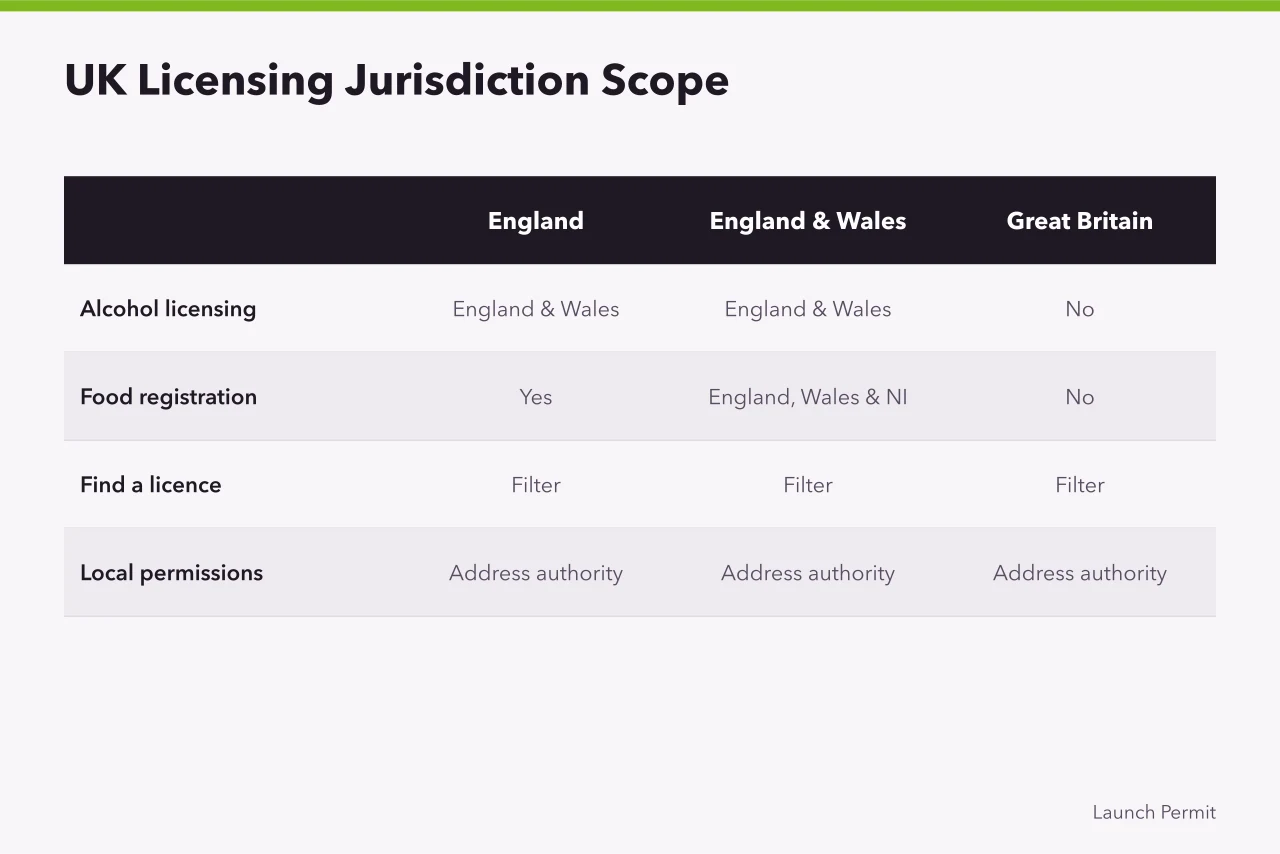
Start every research note with the activity, site, responsible person and nation. The Department for Business and Trade's Find a licence service demonstrates the need for this discipline: it offers location filters for England, Wales, Scotland and Northern Ireland and warns that its catalogue may not include every licence. It is a discovery service, not a complete legal opinion.
For local permissions, identify the authority for the actual address and retain its current page. If a source covers more than England, label the scope beside the claim. Do not quietly combine guidance from two jurisdictions into a single instruction.
- Identify the activity, site, responsible person and nation first.
- Label the jurisdiction beside every claim you publish.
Separate broad frameworks from case decisions
High-level guidance describes a route, while an authority applies it to the facts. The Home Office's alcohol licensing guidance explains the England-and-Wales framework for alcohol supply, regulated entertainment and late-night refreshment. It directs general enquiries to the local licensing authority and describes premises, personal and other routes.
A worked example is the England and Wales premises licence under the Licensing Act 2003. The application goes to the local licensing authority, and the fee follows the premises' non-domestic rateable value rather than the activity alone.
Under the Licensing Act 2003 (Fees) Regulations 2005, band A (rateable value up to £4,300) carries a £100 application fee and a £70 annual charge, while a personal licence application is £37. Two similar venues can therefore owe different sums, so state the band and point readers to the council's current fee page.
Licence Application States
- Acknowledgement
- Application
- Grant
- Conditions to controls
- Refusal / variation
- Hearing / appeal deadlines
A publisher may summarise that structure accurately, with the access date and jurisdiction. It should not tell an operator that approval is assured, that a particular condition will be imposed or that a disputed activity definitely falls outside the regime. Those conclusions require the current facts and responsible decision-maker.
Treat acknowledgements, applications and grants as different states. Retain the authority decision and translate conditions into operating controls. If refusal, variation, hearing or appeal is relevant, preserve deadlines and direct the reader to the authority's published process rather than offering casual legal interpretation.
Make activity boundaries visible
Readers search using business labels, but rules usually attach to actions. The Food Standards Agency's food business registration guidance describes activities such as selling, cooking, storing, handling, preparing and distributing food, with information about multiple establishments. Its stated coverage is England, Wales and Northern Ireland with distinctions.
Food Registration Source Boundaries
Food registration source
- Selling food
- Covered
- Cooking food
- Covered
- Storing food
- Covered
- Handling food
- Covered
- Preparing food
- Covered
- Distributing food
- Covered
Other checks
- Selling food
- Not covered
- Cooking food
- Not covered
- Storing food
- Not covered
- Handling food
- Not covered
- Preparing food
- Not covered
- Distributing food
- Not covered
Use that source to support food-registration claims only. It cannot prove that alcohol, planning, street-trading or environmental questions have been resolved. An ethical guide shows the boundary of each source and keeps adjacent checks open.
Substantiate advertising claims about licensing
A licensing publisher or service provider is still responsible for its marketing. The Advertising Standards Authority's CAP Code section on misleading advertising covers matters including substantiation, material information and comparisons in non-broadcast advertising. Claims about speed, savings, coverage, success or superiority therefore need evidence appropriate to the wording.
Substantiate Advertising Claims
- Substantiation evidence
- Material information
- Comparisons with method
- No guaranteed approval
- Disclose paid placement
- Disclose affiliate relationships
- Disclose ownership interests
Avoid guaranteed-approval language because the provider does not control the authority. If turnaround figures describe the supplier's own work, say so rather than implying a regulator timetable. A comparison must use a stated method and similar services.
Testimonials cannot establish a national approval rate or the legal completeness of a licensing product.
Apply data protection to the whole case journey
Licence applications and support services can collect names, addresses, identity information, premises records and commercially sensitive documents. The Information Commissioner's Office's guide to the data protection principles explains principles including lawfulness, purpose limitation, data minimisation, accuracy, storage limitation and security.
Data Protection Case Journey
- Map each field to purpose
- Minimise identity data
- Limit access by role
- Protect exports
- Set retention decision
- Remove identifiers from examples
- Store consent under controls
Map each field to a purpose before collection. Do not request a complete identity document when a smaller verified data item will do. Limit access according to role, protect exports and set a retention decision for drafts, unsuccessful enquiries and completed cases. A supplier dashboard should not become an indefinite archive by default.
Research and editorial work need the same care. Remove identifiers from examples unless they are necessary and permitted. Store participant consent, recordings and published material under documented controls. If a reader submits personal case details through a general contact route, handle them through the organisation's approved process rather than copying them into an editorial document.
Describe the licensing service in the contract
The contract should state whether the supplier discovers possible requirements, prepares material, submits forms, manages correspondence, maintains renewals or provides professional advice. Each deliverable needs exclusions, customer dependencies, fee treatment and an escalation route.
The Unfair Contract Terms Act 1977 is a primary legislative record relevant to some business liability terms. Its application is fact-specific, and an article cannot determine whether a particular clause is effective. Material exclusions, indemnities, caps, professional responsibilities and termination provisions should be reviewed by a solicitor regulated by the Solicitors Regulation Authority.
Operational clauses matter alongside liability. Define who supplies accurate facts, who approves submissions, what happens when an authority asks for more information and how records are returned at exit. Test whether a deputy could continue a live case if the supplier or main contact became unavailable.
Publish a disclosure policy readers can use
A disclosure policy should answer how items are selected, what was tested, which commercial relationships exist and how errors are corrected. Put a relevant disclosure near the comparison or recommendation, not only in a distant footer.
Distinguish desk research from a product trial and from a real commissioned case. A live first-party page can verify that a service documents a feature or professional route. It cannot prove service quality, accessibility, competence in an individual matter or a successful outcome. Never invent an account, purchase, application or conversation.
Give providers and readers a factual-correction route, but do not sell the right to change independent conclusions. If a paid listing uses the same visual treatment as editorial selection, label it clearly enough for the relationship to be understood before the click.
- Disclose paid placement, affiliate relationships and ownership interests clearly.
Build an editorial evidence file
For each current claim, retain the source URL, publisher, access date, geography and precise proposition supported. Named suppliers, platforms, agencies and professional bodies require their own first-party records. A listicle needs a source for every named entry, not one general link beneath the list.
Separate regulation from method. A regulator page may support what an applicant must do; research guidance supports how the article studied users; a supplier page supports what that supplier says it offers. Combining these evidence types into one vague source note weakens the audit trail.
Manage changes and corrections
Current guidance can move after an article is drafted. Give volatile claims a review date based on consequence and likely change, rather than setting one annual cycle for everything. Links to forms, fee pages and provider offers may need more frequent checking than stable explanations of editorial method.
When a source changes, compare the old and new proposition before editing. Record whether the article needed a factual correction, a scope clarification or only a refreshed link. If earlier wording could have caused a reader to act wrongly, make the correction visible and consider whether affected subscribers or customers need direct notice.
Do not preserve a claim merely because it appeared in a previous approved version. Equally, do not silently rewrite historical statements as though the new rule applied at the earlier date. The amendment log should show what changed, when and which evidence now supports the page.
- Record material amendments and their dates in an evidence file.
Before publication, reopen volatile pages and check links, dates and wording. Remove any claim that the evidence cannot support. Keep internal article suggestions as identifiers until the target pages have passed review.
Use a final rules-and-ethics gate
The gate should ask: Is the jurisdiction explicit? Does each factual statement have a direct source? Are authority decisions distinguished from supplier activity? Are advertising claims substantiated? Is personal information minimised and controlled? Do contracts describe the real service? Are commercial relationships and testing limits disclosed?
Record the writer, fact-checker and, where a legal judgement is involved, a reviewer regulated by the Solicitors Regulation Authority or the Bar Standards Board.
Common questions
What can a supplier page prove about a licensing service?
A live first-party page can verify that a service documents a feature or professional route. It cannot prove service quality, accessibility, competence in an individual matter or a successful outcome.
How should a publisher handle personal data collected through a general contact route?
Handle it through the organisation's approved process rather than copying it into an editorial document, and set a retention decision for the material.
In this guide
- Business licences in England: labelling jurisdiction in research notesA guide to labelling jurisdiction in England business licence research notes, covering licence families, named issuers, fee sources and what to check next.
- Advertising rules for business licences: what consultancies must discloseCheck advertising for England business-licensing services, including evidence, scope, comparisons, approval claims and commercial disclosures.
- Data protection in business licences: from submission to safe disposalProtect personal information in England business-licensing journeys through purpose mapping, minimisation, access controls, retention and safe research.
- Business licences: contract terms for support, authority and exitReview contracts for England business-licensing support by defining deliverables, customer duties, authority boundaries, data handling and exit.
- Business licences disclosure policy for articlesBusiness licences disclosure policy: rules for selection, research labels, commercial ties and corrections in licensing articles.