

Rules and ethics
Starting a business in the UK? What Companies House and council licences each authorise
Start a business in the UK: Companies House incorporation creates a company, but regulated activity needs a council licence or street trading consent.
What to take away
- There are two gatesCompanies House incorporation creates the company, and council licences authorise regulated activities. Pass both before you trade.
- Companies House registration gives you a legal entity, a registered office and directors with statutory duties.
- Councils license premises, street trading, alcohol sales and food businesses; Scotland, Wales and Northern Ireland have their own licensing regimes and some different fees.
- Match your activity to the right permission gate before you incorporate, so you do not pay for a company you cannot use.
- Keep evidence of every stepincorporation certificate, licences, inspection reports and renewal dates.
What Companies House registration actually authorises
Companies House incorporation is the legal birth of a limited company. It creates a separate legal person that can own property, sign contracts, sue and be sued. The application names at least one director, a company secretary if you choose one, shareholders and a registered office address.
Companies House incorporation essentials
- At least one director over 16
- Company secretary if you choose
- Shareholders and shares issued
- Registered office real address
- Unique, non-misleading company name
The registered office is the official address for government mail and is on the public register.
The company can trade from day one, but only in activities that do not need a licence. You can read the core process for setting up a private limited company to see what directors, shares and the registered office involve.
The legal effect is that the company exists, but its permission to operate is limited to what the law allows without further consent.
A director can be anyone over 16 who is not disqualified. The company must have at least one natural person as a director. Shares can be ordinary or have different rights, and the statement of capital records who owns what.
The registered office must be a real address where documents can be delivered, not a PO box. If you use an accountant's address, you need permission. The company name must be unique and not misleading.
After incorporation, the company must file a confirmation statement at least once a year, even if nothing changes. It must also file accounts and update the register of people with significant control (PSC).
The PSC register lists anyone who owns more than 25% of shares or voting rights, or who otherwise controls the company. This is a public record. The company can be fined if it does not keep it up to date.
These duties are part of running a limited company and are enforced by Companies House rather than paid for once and forgotten.
What Companies House does not authorise, and why licensing sits with councils
Companies House registers companies, limited liability partnerships and other entities. It does not grant permission to sell alcohol, provide late night refreshment, run a food business, operate a taxi or trade on the street.
Companies House vs council licensing
Companies House
- Role
- Registrar
- Authorises
- Company existence
- Checks
- Name and documents
- Examples
- Incorporation
Council
- Role
- Licensing authority
- Authorises
- Regulated trading
- Checks
- Public protection
- Examples
- Alcohol, food, taxis
Those permissions come from local authorities, and sometimes from other bodies such as the Environment Agency or the Food Standards Agency. You can read what Companies House authorises and regulates to see that licensing is outside its remit.
Councils license because they are responsible for local public protection. They know the streets, the noise levels, the traffic and the local plan. A premises licence for alcohol or late night refreshment is granted by the licensing authority, usually the council. A street trading consent is granted by the council that manages the street.
A food business registration is made to the council, which then inspects under Food Standards Agency rules. In Scotland, Wales and Northern Ireland, the same broad split applies, but the legal framework and some fees differ.
Scotland has its own licensing boards for alcohol, and Northern Ireland has a different system for pavement cafés.
This is why you can incorporate a company in minutes and still be unable to open a café. The company exists, but the activity does not have consent. If you trade without the required licence, you commit an offence. The council can prosecute, close the premises or refuse future applications.
The council licence layer: premises, street trading and personal licences
The council licence layer is where most founders get stuck. It covers a wide range of activities, but three are common: premises licences, street trading consents and personal licences. Each has its own application, fee and evidence.
Three common council permissions
Premises licence
- Covers
- Alcohol, late night
- Granted by
- Council licensing authority
- Key condition
- Hours, capacity, noise
- Duration
- Ongoing with conditions
Street trading consent
- Covers
- Stalls, vans, pitches
- Granted by
- Street-managing council
- Key condition
- Where and what you sell
- Duration
- Day to a year
Personal licence
- Covers
- Individual supervisor
- Granted by
- Council
- Key condition
- Holds qualification
- Duration
- Usually 10 years
The council licence layer
| Activity | Council permission |
|---|---|
| Selling alcohol | Premises licence, plus a personal licence for the designated premises supervisor |
| Late night refreshment after 11pm | Premises licence |
| Regulated entertainment | Premises licence |
| Selling food | Food business registration, not a licence |
| Trading from a stall, van or pitch on a street | Street trading consent |
| Selling alcohol from a market stall | Street trading consent, and a premises licence if the stall is a premises |
| Operating a taxi or private hire vehicle | Council taxi and private hire licences |
The council premises licence is the main permission for selling alcohol, providing regulated entertainment or late night refreshment. It is granted for a specific address and sets conditions such as opening hours, capacity and noise limits. The application goes to the council's licensing authority, with a copy to the police and other responsible authorities.
There is a public consultation period, usually 28 days, during which objections can be made. If there are no objections, the licence is often granted administratively. If there are, a licensing committee hearing decides.
A street trading consent is different. It allows you to sell goods or services from a stall, van or pitch on a street or in a market. The council that owns or manages the street grants it. Some councils have a street trading policy that sets out where you can trade, what you can sell and the fees.
In London, some streets are managed by the borough, others by the City of London or Transport for London. A consent is usually for a fixed period, from a day to a year, and can be renewed. It is not the same as a premises licence, although a market stall selling alcohol may need both.
You can start with the activity to see how the licence type follows what you actually do.
A personal licence is for individuals who sell or authorise the sale of alcohol. It is granted by the council where you live, and it requires a recognised qualification, such as the Level 2 Award for Personal Licence Holders. You also need a criminal record check.
The personal licence is not tied to a premises; it travels with you. A premises licence needs a designated premises supervisor who holds a personal licence. So if you want to run a pub, you need both: a premises licence for the building and a personal licence for the person in charge.
In Scotland, the equivalent is a personal licence granted by the licensing board, and the qualification is different. In Northern Ireland, the system is different again. Always check the devolved rules.
A food business registration is not a licence, but it is mandatory. You must register with the council at least 28 days before you start trading, unless you are a childminder or a very small operation. The council then inspects and gives a food hygiene rating.
You do not need a licence to sell food, but you do need to comply with food safety law. The Food Standards Agency sets the rules, and the council enforces them. If you sell food and alcohol, you need both the food registration and the premises licence.
If you trade from a van, you may need a street trading consent as well. The layers add up.
Matching your activity to the right permission gate before you incorporate
Before you incorporate, map your activity to the permission gates. A permission gate is any licence, consent, registration or permit that must be in place before you can legally trade. The mistake is to incorporate first and discover later that you cannot get a licence at your chosen site.
Map permission gates before incorporating
- List every activity you will carry out
- Identify the authority for each gate
- Check local licensing and street policies
- Check premises planning use class
- Budget for fees and preparation
A premises licence for alcohol can be refused if there are too many licensed premises in the area, or if the building does not meet fire safety standards. If you have already signed a lease, you are committed. You can use a market entry checklist to test the site and the activity before you commit.
The first step is to list every activity you will carry out. Selling alcohol, selling hot food after 11pm, providing live music and trading on the street each have a gate.
The second step is to identify the authority for each gate. Most are council. Some sit with the Environment Agency, the Health and Safety Executive or a devolved body such as SEPA or Natural Resources Wales.
The third step is to check the local policy. Councils publish licensing policies and street trading policies. These tell you what they expect and what they charge. The fourth step is to check the premises. Does it have the right planning use class? A premises licence does not override planning permission. You may need a change of use.
The fifth step is to budget for fees and preparation, including legal advice, surveys and equipment.
Once you have the map, you can decide whether to incorporate. If the activity is unregulated, such as online consulting, you can incorporate and trade. If it is regulated, you may want to secure the licence or at least confirm it is likely before you commit to a lease.
You can apply for a premises licence before you have a company, as an individual or proposed operator. You must be the proposed operator and provide identification. Many founders still incorporate first because it is quick and cheap, then apply for licences.
You can plan your permission gates to keep that sequence straight.
A worked example: a small café from incorporation to premises licence
Suppose you want to open a small café in Manchester. You will sell coffee, sandwiches and cakes, and you want to sell alcohol with food. You will trade from a unit on a busy street.
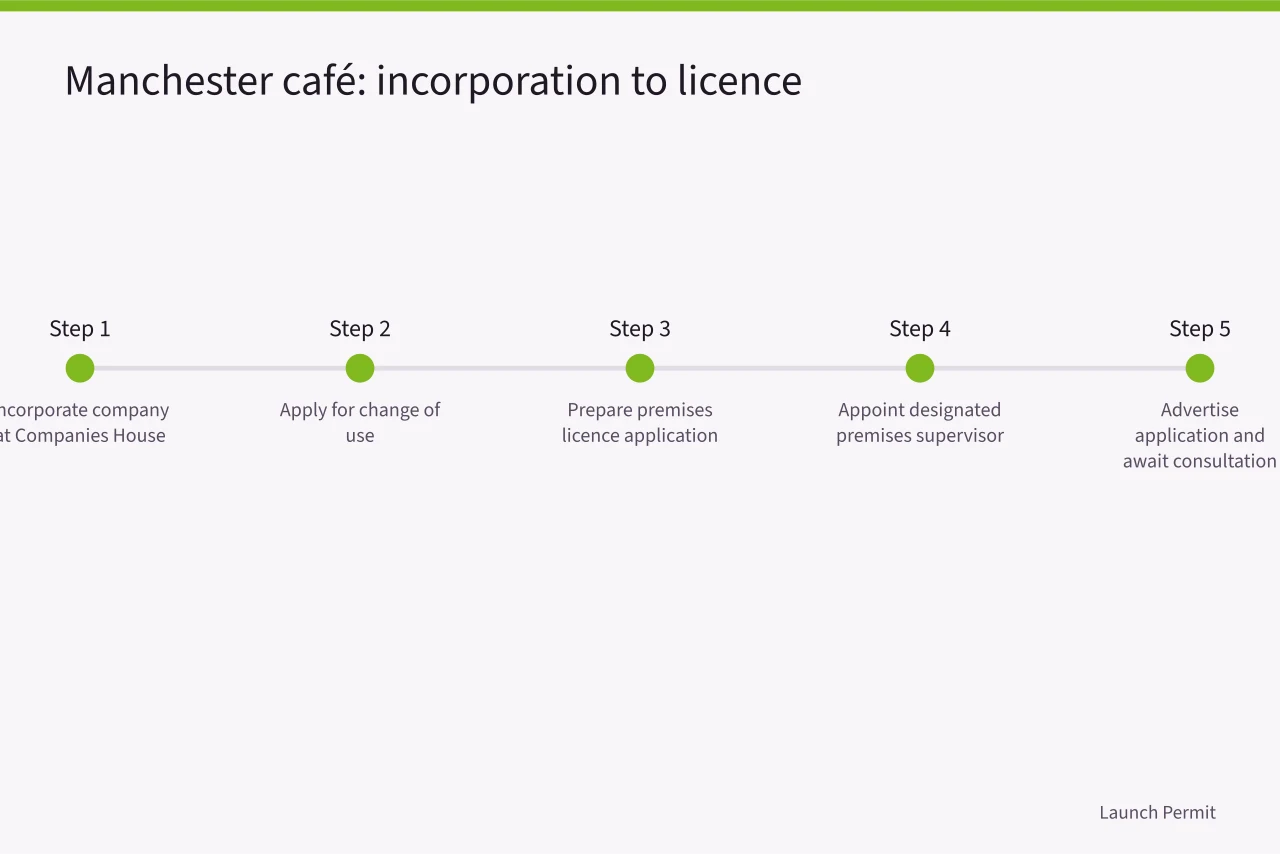
For a café that sells alcohol, the practical order is:
A small café from incorporation to premises licence
- Check the planning use class and apply to Manchester City Council for a change of use if needed.
- Apply for the premises licence as the proposed operator, with a plan, menu and designated premises supervisor.
- Register the food business with the council at least 28 days before opening.
- Incorporate the company at Companies House, then transfer the premises licence to the company if you applied as an individual.
If the rateable value is in Band B, the premises licence application is £635 and the annual fee is £180. Add £50 for online incorporation and £37 for a personal licence application. Food registration is free. The application fee total starts at £722 plus training and any street trading consent.
Directors' duties after incorporation, from confirmation statements to PSC records
After incorporation, directors have statutory duties. These are set out in the Companies Act 2006 and summarised by GOV.UK. You must act within the company's constitution, promote the success of the company, exercise independent judgment, avoid conflicts of interest and declare interests in proposed transactions.
Directors' post-incorporation duties
- Act within the company's constitution
- Promote the success of the company
- Exercise independent judgment
- Avoid conflicts of interest
- Keep accounting records and file accounts
- File confirmation statement every 12 months
- Maintain and file PSC register
You must also keep accounting records, file accounts and file a confirmation statement. You must maintain a register of people with significant control (PSC). The PSC register must be kept at the registered office and be available for inspection.
You must file the PSC information with Companies House. You can check the directors' responsibilities for the full list. Failure to comply can lead to fines or disqualification.
The confirmation statement is not an annual return in the old sense. It confirms that the information Companies House holds is correct. You must file it at least once every 12 months, even if nothing has changed.
You must also file accounts, usually within 9 months of your accounting reference date. Small companies can file abridged accounts, but the filing deadline is strict. If you are a director, you are responsible, even if an accountant does the work.
You must also notify Companies House of changes to directors, registered office or share capital. These filings are public.
The PSC register is separate from the register of members. It records the people who ultimately own or control the company. A person with significant control holds more than 25% of shares or voting rights, or has the right to appoint or remove a majority of directors, or otherwise has significant influence or control.
You must take reasonable steps to identify them.
If there are none, you must say so. The register must be kept up to date and filed with Companies House. This is a legal requirement, not optional. It helps prevent money laundering and tax evasion.
These duties continue as long as the company exists. They are not one-off tasks. You must also comply with licensing conditions. If your premises licence says you must keep a refusals log, you must do it.
If your street trading consent says you can only trade between certain hours, you must follow it. The council can inspect and take action. The company can be prosecuted, and directors can be personally liable in some cases. Keeping evidence of compliance is part of the job.
Costing both steps: Companies House fees against council fees
Companies House incorporation is cheap. The online fee is £50, and the same-day service costs more. The confirmation statement costs £34, and accounts filing is free if filed online. These are set fees, not means-tested.
Key fees at a glance
- £50Companies House online incorporation
- £34Confirmation statement
- £37Personal licence fee
- £200-£400Personal licence course
The real cost is council licensing. Fees vary widely by council and activity. A premises licence fee is based on the rateable value of the premises. In England and Wales, the Licensing Act 2003 sets these bands:
Rateable value band fees
| Rateable value band | Application fee | Annual fee |
|---|---|---|
| Up to £4,300 | £100 | £70 |
| £4,301 to £33,000 | £635 | £180 |
| £33,001 to £87,000 | £900 | £295 |
| £87,001 to £125,000 | £1,200 | £320 |
| £125,001 and above | £1,500 | £350 |
These are standard fees and do not include large event multipliers. A personal licence costs around £37 plus the course, which can be £200 to £400.
A street trading consent is set by the council. Manchester City Council, for example, publishes a street trading policy with fees by pitch and period. Check the current schedule for the exact daily or annual figure.
Food registration is free, but compliance costs money.
Preparation costs are often higher than the fees. You may need a licensing consultant, a solicitor for the lease, an architect for plans, a noise assessment and a fire risk assessment. You may need to advertise the premises licence application in a local newspaper, which can cost £100 to £300.
You may need to pay for a criminal record check for a personal licence. If there are objections, a hearing may require legal representation. These costs are not optional if you want the licence. Budget for them before you sign a lease.
The table below compares the two steps. It is a guide; always check the current fees with the council and Companies House.
Companies House fees against council fees
Companies House
- Purpose
- Creates the company
- Main fee
- £50 online incorporation
- Timing
- Usually within 24 hours
- Evidence
- Certificate of incorporation
- Renewal
- Confirmation statement and accounts
- Who grants
- Companies House
Council licence
- Purpose
- Authorises the activity
- Main fee
- Varies by activity and rateable value
- Timing
- Weeks to months, depending on objections
- Evidence
- Licence certificate and conditions
- Renewal
- Licence renewal and annual fees
- Who grants
- Council licensing authority
Where founders get the sequence wrong, and how to keep evidence of each step
The common mistake is to incorporate first and then discover that the site cannot be licensed. Another is to sign a lease before checking planning. Another is to assume a personal licence covers the premises, or that a premises licence covers street trading. Another is to forget food registration.
Correct sequence and evidence
- Map the permission gates
- Check the site and planning
- Secure permissions or confirm likely
- Incorporate the company
- Trade only once licensed
- Keep evidence for each gate
Another is to trade while the application is pending, which is an offence. The sequence should be: map the gates, check the site, secure the permissions or confirm they are likely, then incorporate, then trade. In practice, many incorporate early because it is quick and allows them to open a bank account.
The sequence is less important than knowing which gate you are at.
Keeping evidence is essential. Create a folder for each permission gate. Store the application, the fee receipt, the consultation responses, the licence certificate, the conditions and the renewal date. Keep a copy of the planning decision and the food registration.
Keep the confirmation statement and PSC filings. If you use a consultant, keep their advice in writing. If you have a case workflow, follow it to track each step from discovery to renewal. This evidence helps if there is an inspection, a dispute or a renewal.
It also helps if you sell the business, because licences may be transferable.
Use a checklist to stay on track. The following is a starting point for a regulated activity.
- List every activity you will carry out.
- Identify the permission gate for each activity.
- Check the council's licensing policy and street trading policy.
- Confirm the premises has the correct planning use class.
- Apply for a personal licence if you will sell alcohol.
- Advertise the premises licence application correctly.
- Register the food business at least 28 days before opening.
You can also start your business on GOV.UK to see the full list of licences and registrations for your activity. You can read the step-by-step incorporation process to see what Companies House registration authorises.